Introduction
When planning an interior design, renovation, or complete interior fit-out, the final quotation is influenced by much more than the size of the space. Materials are one of the most important factors affecting interior design project quotations, because different materials have different costs, finishes, durability, installation requirements, and maintenance needs.
A kitchen with standard finishes can have a very different quotation from a premium custom kitchen, even when both have similar dimensions. The same applies to wardrobes, TV wall units, feature walls, gypsum ceilings, flooring, and other interior elements.
Understanding how materials affect the final quotation helps homeowners and businesses make better decisions, compare quotations fairly, and allocate their budgets more effectively.
At Prestige Bluestar Interiors, we help clients select suitable materials and finishes while developing practical interior solutions that balance aesthetics, functionality, durability, and budget.
Why Materials Affect Interior Design Project Quotations
Materials influence the cost of an interior design project in several ways. Their purchase price is only one part of the calculation. Material specifications can also affect fabrication, wastage, hardware, labour, transportation, and installation.
Important cost factors include:
- Material type and quality
- Thickness and specifications
- Surface finish
- Quantity required
- Material wastage
- Hardware and accessories
- Fabrication requirements
- Installation complexity
- Availability and sourcing
- Transportation and logistics
This is why two interior design quotations for a similar project can have significantly different final prices.
A professional quotation should clearly identify the materials and specifications being offered rather than providing only a lump-sum figure.
How Material Selection Changes the Final Quotation
1. Material Quality and Specifications
The quality of materials selected has a direct effect on an interior design project quotation.
For custom kitchens, wardrobes, TV wall units, and other cabinetry, the type of board, thickness, finish, internal configuration, and hardware can all affect the final price.
Premium materials may cost more initially, but they can provide better durability, appearance, moisture resistance, and long-term performance.
The cheapest material is therefore not always the most economical choice. The right material should match the intended use, expected lifespan, design requirements, and available budget.
2. Finishes Influence Interior Design Costs
The selected finish can significantly change the cost of an interior project.
Common finishes include:
- Laminate
- Veneer
- Acrylic
- PU paint
- Decorative panels
- Fluted panels
- Wood-effect finishes
- Glass
- Mirrors
For example, a standard laminate wardrobe and a wardrobe with a premium acrylic or specialist painted finish may have very different quotations.
A detailed quotation should therefore state the proposed finish instead of simply listing “wardrobes” or “kitchen cabinets.”
3. Hardware and Accessories Add Value and Cost
Hardware is another important part of an interior design quotation.
Cabinetry may require hinges, drawer runners, handles, soft-close mechanisms, sliding systems, pull-out pantry units, corner storage systems, and wardrobe accessories.
Premium hardware can increase the initial project cost but may improve functionality, durability, and ease of use.
When comparing quotations, always check whether the hardware is included and whether both contractors are offering comparable specifications.
4. Custom Designs Require More Fabrication
Bespoke interior elements can increase the project cost because they require additional design development, fabrication, materials, and installation.
Examples include:
- Custom TV wall units
- Built-in wardrobes
- Walk-in closets
- Bespoke kitchen cabinets
- Decorative feature walls
- Detailed gypsum ceilings
- Custom office reception counters
- Integrated LED lighting
A customized design can provide greater functionality and a more distinctive appearance, but its quotation should reflect the additional work involved.
How Different Interior Materials Affect Project Costs
Different areas of an interior project have their own material considerations.
Kitchen Cabinets
Kitchen quotations can vary according to cabinet board, door finish, hardware, internal storage accessories, countertop, backsplash, and installation.
Premium finishes and specialized storage systems may increase the initial investment but can improve the kitchen’s functionality and appearance.
Wardrobes and Walk-In Closets
Wardrobe costs can depend on board material, door style, internal storage, handles, hinges, drawer systems, mirrors, lighting, and accessories.
A basic wardrobe and a fully customized walk-in closet should not be expected to have the same cost per square metre.
TV Wall Units and Feature Walls
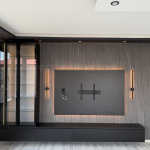
TV wall units often combine several materials, such as cabinetry, decorative panels, mirrors, fluted finishes, lighting, and shelving.
Adding more materials and design details increases fabrication and installation requirements, which affects the final quotation.
Flooring
Flooring costs can include the selected flooring material, preparation, adhesives, cutting, wastage, skirting, labour, transportation, and installation.
A lower material price does not necessarily mean a lower completed-floor cost.
Gypsum Ceilings
Gypsum ceiling quotations can vary depending on the ceiling design, number of levels, decorative details, lighting provisions, access, and finishing requirements.
A simple flat ceiling requires less fabrication than a highly detailed ceiling with multiple levels, curves, bulkheads, and integrated lighting.
Why Material Wastage Matters in an Interior Design Quotation
Materials cannot always be used without generating waste.
Boards, tiles, panels, flooring, and other materials may need to be cut around corners, openings, walls, doors, windows, and design features.
The actual quantity required may therefore be higher than the visible surface area.
A professional quotation should consider realistic material requirements, cutting patterns, and wastage when calculating project costs.
This is particularly important for larger projects where even a small difference in material quantities can have a noticeable impact on the total budget.
Why Two Interior Design Quotations Can Have Different Prices
It is normal for different interior designers or contractors to provide different quotations for what appears to be the same project.
The difference may result from:
- Different material specifications
- Different finishes
- Different hardware
- Different quantities
- Different workmanship standards
- Different labour costs
- Different design complexity
- Different installation methods
- Different project management services
- Different exclusions
For this reason, the cheapest quotation is not necessarily the best quotation.
Instead, compare quotations based on the scope, materials, specifications, workmanship, inclusions, exclusions, and expected final result.
How to Compare Interior Design Project Quotations
When comparing an interior design quotation, start with the specifications rather than the final figure.
Check whether the quotation clearly explains the scope of work, materials, finishes, quantities, hardware, labour, installation, transportation, project timeline, payment terms, and exclusions.
For larger projects, an itemized Bill of Quantities can make the cost structure easier to understand.
A useful question to ask when comparing quotations is:
“Are both quotations offering the same quality and scope?”
If the answer is no, the prices cannot be compared fairly.
How to Control Your Interior Design Project Budget
If your preferred design exceeds your budget, you do not necessarily need to abandon the concept.
Instead, consider value engineering. This can involve selecting alternative finishes, simplifying decorative details, choosing standard hardware where appropriate, reducing unnecessary customization, or prioritizing premium materials in high-impact areas.
For example, premium materials can be reserved for a main TV wall or kitchen feature while more cost-effective finishes are used in secondary areas.
This approach can help maintain the overall design character without compromising the entire project budget.
Why Choose Prestige Bluestar Interiors?
Prestige Bluestar Interiors provides professional interior design and renovation solutions for residential and commercial spaces.
Our services include:
- Custom kitchen cabinets
- Wardrobes and walk-in closets
- TV wall units
- Gypsum ceilings
- Wainscoting and wall finishes
- Office partitioning
- Flooring
- Custom cabinetry
- Home renovations
- Complete interior fit-outs
We understand that every project has different requirements. Our approach is to help clients make informed decisions about materials, finishes, functionality, and budget before execution begins.
From design concepts and material selection to custom fabrication and installation, Prestige Bluestar focuses on creating interiors that combine quality workmanship, practical functionality, and lasting visual appeal.
Frequently Asked Questions
How do materials affect an interior design quotation?
Materials affect the quotation through their quality, type, thickness, finish, quantity, wastage, hardware, fabrication, labour, and installation requirements.
Why are interior design quotations different?
Different quotations can use different materials, finishes, hardware, quantities, workmanship standards, labour costs, and project scopes.
Can changing materials reduce interior design costs?
Yes. Alternative materials and finishes can reduce costs while maintaining the overall design concept. The alternatives should still be suitable for the intended application.
Should materials be listed in an interior design quotation?
Yes. Important materials, finishes, hardware, and specifications should be clearly identified so the client understands what is included.
Is the cheapest interior design quotation the best?
Not necessarily. A cheaper quotation may use lower specifications or exclude certain works. Compare the complete scope and specifications before making a decision.
How can I control my interior design budget?
Define your scope and budget early, select materials carefully, compare like-for-like quotations, and discuss value-engineering options with your interior designer.
Conclusion
Understanding how materials affect the final interior design project quotation allows homeowners and businesses to make more informed decisions when planning an interior project.
Material quality, finishes, hardware, quantities, customization, wastage, fabrication, labour, installation, and logistics can all contribute to the final cost.
When comparing an interior design quotation, do not focus only on the total amount. Look at what materials are being used, what specifications are included, the quality of workmanship, and exactly what the quotation covers.
The goal should not simply be to find the cheapest quotation. It should be to achieve the right balance between quality, functionality, aesthetics, durability, and budget.
Ready to Get Your Interior Design Project Quotation?
Prestige Bluestar Interiors specializes in custom kitchen cabinets, wardrobes and walk-in closets, TV wall units, gypsum ceilings, wainscoting, office partitioning, home renovations, and complete interior fit-outs.
If you are planning an interior project and want to understand how different materials, finishes, and design specifications will affect your final quotation, our team can help you develop a practical solution based on your space, requirements, and budget.
Book your professional site visit and design consultation today.
📞 +254 714 444 516
📞 +254 745 730 042
📍 Westlands, Nairobi, Kenya
Serving homeowners and businesses nationwide across Kenya.
Professional site visit and design consultation fees apply before quotation and project commencement.