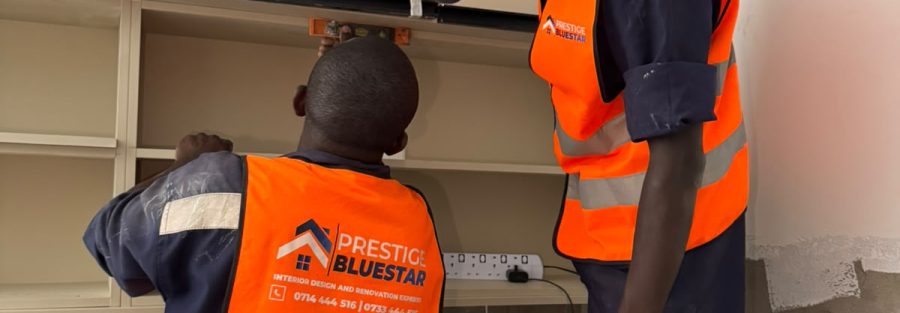
Interior Project Execution | Why Quality Workmanship Matters
A successful interior project is not determined by the design alone. The quality of execution plays an equally important role in determining how the finished space looks, functions and performs over time.
This is why quality workmanship matters during interior project execution.
A beautiful design can lose its impact when measurements are inaccurate, cabinetry is poorly aligned, joints are visible, finishes are inconsistent or installations are not properly coordinated. On the other hand, skilled workmanship helps translate an approved design into a finished interior that is precise, functional and visually refined.
For homeowners, property developers, offices and commercial spaces undertaking an interior fit-out in Kenya, workmanship should therefore be considered alongside design, materials, budget and project management.
What Is Quality Workmanship in Interior Project Execution?
Quality workmanship refers to the standard, precision and care applied while carrying out the actual work.
It involves more than simply completing an installation. It includes accurate measurements, proper preparation, correct installation techniques, attention to detail, appropriate material handling and careful finishing.
In a custom interior project, quality workmanship can be seen in details such as:
- Accurate cabinet and wardrobe alignment
- Clean and consistent joints
- Correct door and drawer operation
- Proper installation of hardware
- Neat gypsum ceiling finishes
- Consistent wall and decorative finishes
- Accurate feature-wall installation
- Proper coordination of lighting and electrical points
- Clean edges and finishing details
- Proper final adjustments
These details may appear small individually, but together they determine the quality of the finished interior.
Why Does Quality Workmanship Matter in Interior Fit-Out Projects?
Interior fit-out projects involve several interconnected activities. A mistake at one stage can affect another stage later.
For example, inaccurate measurements can affect cabinetry. Poor coordination can affect lighting positions. Uneven surfaces can affect finishing. Incorrect installation can affect how doors, drawers or storage systems operate.
Quality workmanship helps reduce these problems by ensuring that each stage is executed according to the approved design and specifications.
It also supports three important project outcomes: appearance, functionality and durability.
A professionally executed interior should not only look good on completion day. It should continue to function properly as the client uses the space.
Quality Workmanship Improves Durability
The durability of an interior installation depends on several factors, including material quality, design, installation methods and everyday use.
Even good materials can perform poorly when they are incorrectly installed or handled.
For example, cabinetry requires appropriate alignment, secure fixing and correctly installed hardware. Gypsum ceilings require properly executed frameworks, board installation and joint treatment. Decorative finishes require suitable preparation before the final finish is applied.
Quality workmanship helps ensure that materials are used and installed according to their intended purpose.
This can reduce premature defects, unnecessary repairs and avoidable rework.
Precision Matters in Custom Interior Installation
Custom interiors depend heavily on measurements and precision.
A wardrobe, kitchen cabinet, TV wall unit or other fitted feature is designed around the dimensions and characteristics of a particular space. Small measurement errors can therefore create noticeable problems during installation.
Precision workmanship helps achieve:
- Correct dimensions
- Consistent alignment
- Even gaps
- Level installations
- Proper door and drawer operation
- Clean transitions between materials
- Better integration with surrounding finishes
This is especially important where several custom elements need to work together within the same room.
Quality Workmanship Improves Functionality
Interior design should solve practical problems, not only create attractive spaces.
A kitchen should provide convenient storage and usable working areas. A wardrobe should organise clothing effectively. A TV wall should accommodate the television, storage and relevant services. An office partition should support the intended layout and use of the workspace.
Quality workmanship ensures that the final installation works as intended.
Doors should open and close correctly. Drawers should operate smoothly. Shelves should be properly positioned. Cabinetry should be securely fixed. Lighting should be coordinated with the design.
Good execution turns a design concept into a functional space.
Workmanship Affects the Final Appearance
The final appearance of an interior is strongly influenced by installation quality.
Even high-quality materials can look unfinished when installation is careless.
Clients should pay attention to details such as:
- Alignment of cabinet doors
- Consistency of gaps
- Straightness of lines
- Clean corners
- Neat joints
- Surface preparation
- Paint consistency
- Finishing around fixtures
- Hardware alignment
These details contribute to the visual quality of the completed project.
In premium interior work, precision is often what separates an average installation from a professionally finished one.
Quality Control During Interior Project Execution
Quality should not be checked only after everything has been installed.
A stronger approach is to incorporate quality control throughout project execution.
Depending on the project, checks can take place during:
- Site measurement and preparation
- Design and specification approval
- Material procurement
- Workshop fabrication
- Installation
- Finishing
- Final inspection
Staged quality checks make it easier to identify and correct issues before they affect subsequent work.
For example, checking measurements before fabrication is more effective than discovering a dimensional problem after installation. Similarly, checking framework and preparation before final finishing can help prevent expensive rework.
How Poor Workmanship Can Affect an Interior Project
Poor workmanship can create both visible and hidden problems.
Visible issues may include uneven finishes, misaligned cabinetry, inconsistent joints, rough edges and poor paintwork.
Other problems may become noticeable only after the project is completed, such as loose fittings, poorly operating doors, inadequate fixing or premature deterioration.
Poor workmanship can also lead to:
- Additional repair costs
- Rework
- Project delays
- Material wastage
- Client dissatisfaction
- Reduced functionality
- Poor long-term performance
This is why choosing an interior contractor should involve evaluating how the work is executed, not only how the completed photographs look.
How Clients Can Identify Quality Workmanship
Clients do not need to be construction specialists to ask meaningful questions about workmanship.
Before engaging an interior contractor, ask about:
- Previous projects with similar scope
- Materials and specifications
- Measurement procedures
- Fabrication standards
- Installation methods
- Quality-control procedures
- Project supervision
- Handling of defects or corrections
- Communication during execution
When reviewing completed work, look beyond the overall photograph. Examine the alignment, edges, joints, hardware, finishes and functionality.
The details often reveal the quality of the execution.
Why Professional Project Management Matters
Quality workmanship and project management work together.
A skilled installer still needs accurate drawings, approved specifications, suitable materials, proper sequencing and clear instructions. Likewise, good project management cannot compensate for poor workmanship.
Professional project management helps coordinate:
Design → Approval → Procurement → Fabrication → Installation → Finishing → Quality Inspection → Handover
At Prestige Bluestar Interiors, our approach combines precision quality workmanship, professional project management and a smooth customer journey.
The objective is to ensure that the approved design is executed with attention to detail while maintaining communication and coordination throughout the project.
Why Choose Prestige Bluestar Interiors?
Interior fit-out requires a balance between design, materials, workmanship and project management.
Prestige Bluestar Interiors provides custom interior solutions including kitchen cabinets, premium wardrobes, walk-in closets, TV wall units, gypsum ceilings, wainscoting, office partitioning, renovations and complete interior fit-outs.
Our focus is on understanding the client’s requirements, executing the approved scope accurately and maintaining professional standards throughout the project.
For clients looking for an interior fit-out in Kenya, the goal should not simply be to find the lowest quotation. It should be to find a contractor capable of delivering the required combination of quality materials, precision workmanship, professional management and reliable execution.
Frequently Asked Questions
Why is workmanship important in interior projects?
Workmanship affects the appearance, functionality, durability and overall quality of an interior installation. Good workmanship helps ensure that materials and designs are executed correctly.
What does quality workmanship include?
It includes accurate measurements, proper preparation, precise installation, clean finishing, correct hardware installation, alignment, secure fixing and attention to detail.
Can good materials compensate for poor workmanship?
No. Good materials are important, but incorrect installation can reduce their performance, appearance and durability.
How can I assess an interior contractor’s workmanship?
Review completed projects and examine details such as alignment, joints, edges, hardware, finishes and functionality. Ask about their quality-control and project-management processes.
Does workmanship affect the project timeline?
Yes. Poor workmanship can result in defects, rework and delays. Proper execution and staged quality checks can help reduce unnecessary rework.
Is quality workmanship important for a complete interior fit-out?
Yes. A complete fit-out involves multiple rooms, materials and trades, making precision, coordination and quality control especially important.
Conclusion
Quality workmanship is one of the foundations of successful interior project execution.
Design establishes the vision, materials provide the physical components and project management coordinates the process. However, workmanship is what ultimately brings these elements together in the finished space.
From custom kitchens and wardrobes to TV wall units, gypsum ceilings, wainscoting and complete interior fit-outs, precision matters at every stage.
For an interior fit-out in Kenya, clients should therefore evaluate contractors based not only on design ideas and pricing, but also on their ability to deliver accurate, functional and carefully finished work.
The best interior projects are planned properly, managed professionally and executed with attention to detail.
Ready for a Quality Interior Fit-Out?
Planning a new interior project or complete fit-out? Contact Prestige Bluestar Interiors to discuss your requirements, project scope, design needs and execution plan.
Call/WhatsApp: +254 714 444 516 | +254 745 730 042
Email: info@prestigebluestar.com
Website: www.prestigebluestar.com
Professional onsite consultation fees apply.